


Hello, on Gaming&Co today:
Blacklist: France and Germany the two largest illegal gambling markets in Europe
News round-up: French fine; Rank MGD; Polymarket lobbying; DKNG sell-off
High five: KSA issues first round of follow-up licences in Netherlands
NIBS: Sharp Vision, Bet-at-home, Tim Miller, Boyle Sports
Subscribe to Gaming&Co!
France and Germany drive EU’s illegal iGaming market
Population levels and restrictive regulations act as drivers of illegal activity
Unwanted podium: France and Germany are the two largest illegal gambling markets in Europe, with each valued at around €4bn and €3bn respectively, according to new research seen by Gaming&Co.
The volume comes as illegal operators target specific product gaps in markets like France, where online casinos are not regulated and black market websites include the words ‘slot’ or ‘slots’ in dot fr domain names, according to further analysis of the EUROMAT-commissioned study published 10 days ago.
Name unknown: As requested by EUROMAT, G&Co agreed not to publish the names of the websites. The full report, carried out by Regulus Partners and web consultancy Helios, also revealed that the estimates of those two countries’ illegal iGaming markets were “conservative”, even though they represent nearly 60% of the €12bn unregulated operators generated in 2025.
Distortion pedal: While France provides “sufficient consumer choice with 25 licensed sites”, it “distorts betting prices” with its maximum RTP ratio of 85% for sports betting, while the lack of regulated online casino and “punitive rates of revenue tax all favour high rates of leakage to the Black Market”, said the report.
Previous estimates valued France’s unregulated online gaming market at €1.5-€2bn, but the report noted that its black market is “the largest in Europe due to the size of the country’s economy and population combined with the scale of the restrictions in place”.
It added that “overall consumer expenditure patterns on gambling suggest that our calculation of a €4bn Black Market is likely to be conservative”.
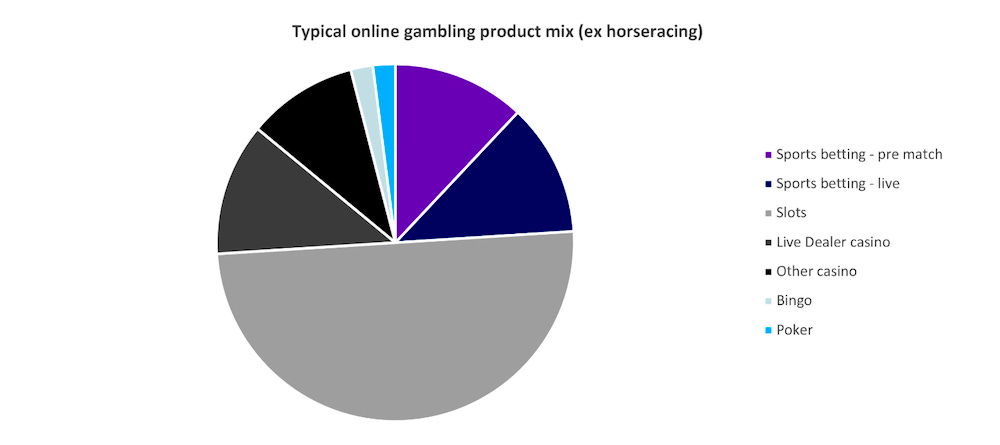
Online slots make up half the illegal market’s activities
German friction
Despite some 136 licensed sites operating in Germany, “player frictions are currently severe across several key areas” such as in-play betting being restricted to match outcomes and online slots limited to €1 per spin (with 5 second gaps between each spin).
T/O tax hands the advantage: The country’s 5% turnover tax for betting gives illegal operators “a price advantage for singles bets”, around “50% price advantage for slots” and the “€1,000 per month deposit limits impact the majority of higher value of players”, the report added.
Facing facts: The Gemeinsame Glücksspielbehörde der Länder, Germany’s gambling regulator, has quoted an estimate of around €500m for the country’s illegal online gambling market with channelisation rates of 77%.
But online activity and “the lack of regulated growth (-2% CAGR) compared to all other markets” suggests a market value closer to €3bn, which “still puts Germany at the low end of comparable international expenditure”, noted the report.
Germany launched its regulated market five years ago and this week GGL called for extra powers so it can tackle illegal operators more quickly. According to the regulator, new business models, technical structures and forms of illegal gambling are evolving faster than current legislation can be adapted.
Crypto-power raises the stakes
The rise of crypto currencies is a defining feature of the illegal market, with the report noting that crypto-gambling operators are “now large enough to have recognisable brands across multiple jurisdictions” thanks to wide-scale advertising and sponsorship activities.
In addition, the largest black market operators “have scaled to create recognisable brands with traffic that can compare to domestically licensed operations”. The top six groups for illegal market share all operate crypto-gaming websites and represent 43% of the market’s €12bn estimated value.
Singular factor: Cryptocurrencies give the sites “a clear level of differentiation against licensed online gambling providers and a clear means of circumventing any traditional payment blocking measures that might be in place”.
Misleading averages: Player behaviour, especially from higher spending ones, also has a major impact on official data and how consumers approach the issue of illegal iGaming. Players in countries like Spain or the UK play, on average, on two different gaming and betting accounts.
However, the report said a more detailed analysis of UK player behaviour revealed “that nearly half of all active customers have only one account (44%), meaning that the average for the remaining 56% is 3 active accounts per player”.
Looking at the most active and highest spending players, the top 10% of active players, who are often VIPs, “have 10 or more active accounts” across both regulated and unregulated websites.
Another recent study into illegal iGaming in Europe valued the market’s GGR at €91bn, but analyst Alun Bowden said the figures were not “plausible”.

The Conexus Group celebrates 25 years of business and continues to dedicate itself to driving growth and success across the global iGaming industry, including helping land-based and retail casinos transition online. Our key brands — Pentasia, Partis, iGaming Academy, and Incline — deliver specialised human capital solutions, M&A advisory, strategic consulting, training and managed services.
Conexus builds long-term relationships and provides deep sector knowledge, including expertise in the French market, to solve complex challenges. By orchestrating these services under one group, Conexus offers clients a streamlined partnership for enhanced performance and sustainable success.
Contact us for more information
News roundup

French operator fined €20k for AML and terrorism financing failures
Monitoring failures: France’s National Sanctions Committee (CNS) has fined an unnamed operator €20,000 for failures linked to its anti-money laundering and terrorism finance monitoring and compliance requirements. The penalty is the first of its kind in France, said the gambling regulator, Autorité Nationale des Jeux.
The operator concerned was named as ‘GU’ and is believed to be Betsson France. However the company did not confirm this or reply to a request for comment from Gaming&Co.
ANJ said the company is listed on one of the NASDAQ exchanges and was fined for allowing a person on France’s money laundering and terrorism watchlist to open an account. It should have frozen the account and any funds deposited and alerted the relevant minister, said ANJ.
The fine also came with two-month suspended sentences for the group and two of its senior executives, who were also fined €20,000 and €5,000 respectively. ANJ urged operators to stay on top of and enhance their AML and terrorism financing monitoring activities.
Deutsche Bank: MGD hike could wipe 44% off Rank’s 2028 EBIT
Taxing times: Rank Group would be the UK operator hit hardest by a rise in Machine Games Duty (MGD), according to a new note from Deutsche Bank. It was reported earlier this month that Chancellor John Healey is considering an MGD increase, following a recommendation from influential think tank the Social Market Foundation.
Deutsche Bank estimates that doubling MGD to 40% would add around £35m to Rank's annual duty bill – equivalent to 44% of its forecast 2028 EBIT, and 24% of nearer-term EBITDA before mitigation, or 17% after.
In contrast, Flutter would be largely protected by its US focus: it would pay under $20m in extra retail duty, less than 1% of group EBITDA, Deutsche Bank said.
Entain has already confirmed it would face around £100m in extra costs before mitigation. That equals roughly 10% of FY27 EBITDA and 20% of FY28 free cash flow.
The bank said retail operators can offset only about 30% of tax rises, against roughly 50% for online operators, which raises the risk of venue closures.
Speaking during Rank Group’s latest investor update earlier this month, CEO Richard Harris warned any increase in MGD would be “nonsensical from an economic perspective”.
Polymarket lobbies Europe to be treated as a financial firm
Behind the scenes: Polymarket is lobbying European regulators to classify it as a financial services provider rather than a gambling operator, as it tries to get back into markets that have shut it out. The prediction market has held talks with the European Securities and Markets Authority (ESMA), the European Commission and the UK’s Financial Conduct Authority. It wants its contracts to fall under MiFID II, the EU’s rules for financial instruments.
Setbacks: The push follows a run of setbacks in Europe. France banned Polymarket in 2024, ruling that its service was unlicensed gambling. In June, nine European regulators announced a joint crackdown on unlicensed prediction markets, then a month later Italy blacklisted the site, which ended its sponsorship of Serie A outfit Lazio.
ESMA’s July guidance gives Polymarket some footing. It confirmed that binary, fixed-payout prediction contracts are financial instruments, some of them derivatives under MiFID II. However, it labelled them “restricted”.
The move came as Polymarket was sued by New York for being an “illegal, unlicensed gambling operation”. The lawsuit comes two months after the state sued Kalshi over similar allegations.
Prediction market spend lowers DraftKings forecast
Near-term headwinds: Citizens has cut its 2026 EBITDA forecast for DraftKings to $532m amid increasing spend on prediction markets by the operator. The bank now expects the firm to spend up to $500m on its event contracts business this year, well above initial guidance.
The new estimate implies a 14% YoY fall in EBITDA. Citizens expects $450m-$500m of prediction market spend, against DraftKings’ guidance of $200m-$300m and a consensus of about $275m.
The revision follows comments from CEO Jason Robins this week. Speaking at the Wells Fargo Consumer Conference, he said DraftKings will invest “meaningfully more” in the second half of the year and bring some 2027 spend forward. DraftKings shares subsequently lost around $800m in value.
Citizens said the sell-off “highlights how investors are currently viewing any incremental investment in prediction markets as a near-term headwind”. It is assuming another $450m of spend in 2027.
Robins remains bullish, predicting annualised prediction market volume could approach $9bn in September. That would be worth around $350m in exchange and broker revenue even with no further growth, Citizens said.
CFTC advisory “effectively shuts down” most mention markets
Don’t mention it: Analysts at investment bank TD Cowen have said new guidance from the US Commodity Futures Trading Commission (CFTC) will effectively shut down the vast majority of ‘mention markets’, the event contracts that settle on whether someone says a particular word or attends a particular event.
The six-page staff advisory, issued by the CFTC’s Division of Market Oversight says these contracts carry a “heightened risk of manipulation” because the people involved may know the outcome in advance.
In a note, TD Cowen said the advisory creates a presumption that mention markets are readily susceptible to manipulation. Under Core Principle 3, designated contract markets (DCMs) are barred from listing contracts of that kind.
The CFTC has stopped short of an outright ban. A DCM can still list a mention market if it demonstrates four elements: independent obligations constrain the individual involved, the individual is free from external pressure, the outcome can be independently verified and robust surveillance and controls are in place.
TD Cowen called that “a difficult standard for a mention market to meet”.

Soft2Bet Scores Canadian Expansion with Hamilton Tiger-Cats Partnership
Soft2Bet’s brand ToonieBet has expanded its North American footprint through a new partnership with the Canadian Football League’s Hamilton Tiger-Cats. The multi-year deal positions ToonieBet as the team’s official iGaming partner and includes naming rights to the Hamilton Stadium club level, now the ToonieBet Club.
The move strengthens Soft2Bet’s expansion strategy, blending sustained market growth with fan-first, digital engagement. For investors, it signals continued disciplined expansion in North America, anchored in sports-led brand integration and local market alignment.

KSA renews licences as Dutch market reaches five years
Eight operators receive follow-up licences ahead of October deadline
Five-year plan: The Dutch Gambling Authority (KSA) has granted eight follow-up licences, the first renewals since the regulated online market opened in October 2021. TOTO, Holland Casino Online, Kansino, FairPlay Casino, Bingoal, bet365, GGPoker and Betcity will all be licensed from 1 October 2026 to 30 September 2031. All eight were among the ten operators that launched the market. The other two, LiveScore and tombola, left the Netherlands by 2024.
This round was the first under stricter licensing rules in force since January. Applicants had to show what they had done to correct past breaches and how they would stop them happening again. For the first time, they also had to submit an exit plan.
“Providers that made mistakes in the past five years must explain how they have learned from previous mistakes and how they intend to prevent recurrence,” the KSA said.
No new operators were licensed in this round. More operators will need to renew as the licences granted after launch approach their five-year expiry.
Across the border, Gaming1 has acquired Belgian online casino Carousel.be, along with its B+ licence, from the De Backer family. The family will keep running its 711 brand separately, including 711.nl, which has held a Dutch licence since April 2022. The transaction amount was not disclosed.

Kambi is unveiling a new brand identity and strategic promise: Powerful Network. Proven Edge.
The sports betting industry is entering a new era. AI, data and automation are changing what sportsbooks can offer and how it is packaged and presented to players. For operators, the opportunity is clear: sharper pricing, stronger risk management, richer products and a more tailored player experience. That is where Kambi’s network creates a proven edge.
Every operator connected to it contributes to, and benefits from, a continuously improving ecosystem built around data, trading quality, AI capability and regulated-market experience. As player expectations continue to evolve, our dynamic sportsbook helps operators create betting experiences that are more responsive, relevant and profitable.
To find out more, visit www.kambi.com
News shorts
French regtech provider Sharp Vision has announced a new partnership with Lotería Nacional de Beneficencia in Salvador. The agreement is Sharp Vision’s first client win in Latin America, where it will provide Salvador’s national regulator with its technology and products to follow the activities of regulated operators’ activities, identify illegal gambling websites and strengthen tracking controls.
Bet-at-home recorded losses of €2.2m in the first half of 2026 compared with a €1.8m over the same period in 2025 as GGR dropped 4% YoY to €24.3m with EBITDA losses of -€1.8m. The latter drop was attributed to a sharp 26% rise in marketing and advertising expenses to €10.3m, linked to the World Cup. The company said the showpiece tournament had a “positive impact” but noted “major sporting events typically generate not only positive momentum, but are also associated with increased marketing expenses”.
Tim Miller, formerly executive director at the Gambling Commission, has launched GamReg Consulting, a global advisory firm focused on tackling illegal gambling. He left the Commission in June, after a tenure spent pressing Big Tech and social media over their role in promoting unlicensed operators. Former UKGC CEO Andrew Rhodes joined advisory firm Hawkbridge the same month.
Boyle Sports has signed former Newcastle and Tottenham winger David Ginola to front a campaign for its new Squad Builder product. In the ads, which take inspiration from the film The Big Short, the Frenchman explains the product directly to camera. Squad Builder lets customers pick two to five players and choose from seven statistical targets. The 60-second and 30-second spots launched this week.

Play’n GO is launching into land-based casinos.
After more than 20 years at the forefront of iGaming, Play’n GO is bringing its world-famous games to land-based spaces. Play’n GO’s unrivalled portfolio of some of the world’s most played online casino games is now available for physical casinos, giving operators the opportunity to harness the power and growth of online casino to bring a new demographic of players into their brick and mortar spaces. With cabinets already placed with one of the biggest casino chains in the world, Play’n GO’s CEO Johan Tornqvist said “We are bringing the best of online casino content and features to casino floors worldwide.”
For more info, visit www.playngo.com
Calendar
Results: 15 Oct: Entain, 21 Oct: FDJ United, 22 Oct: Betsson, 23 Oct: Evolution
Events: 29 Sept-1 Oct: SBC Summit Lisbon, 15 Oct: Gaming in Spain, 10 Nov: Gaming in Germany, Berlin
Contact
Get in touch with Jake Pollard for all editorial, sponsorship and partnership opportunities at Gaming&Co: jake@gamingandco.info